
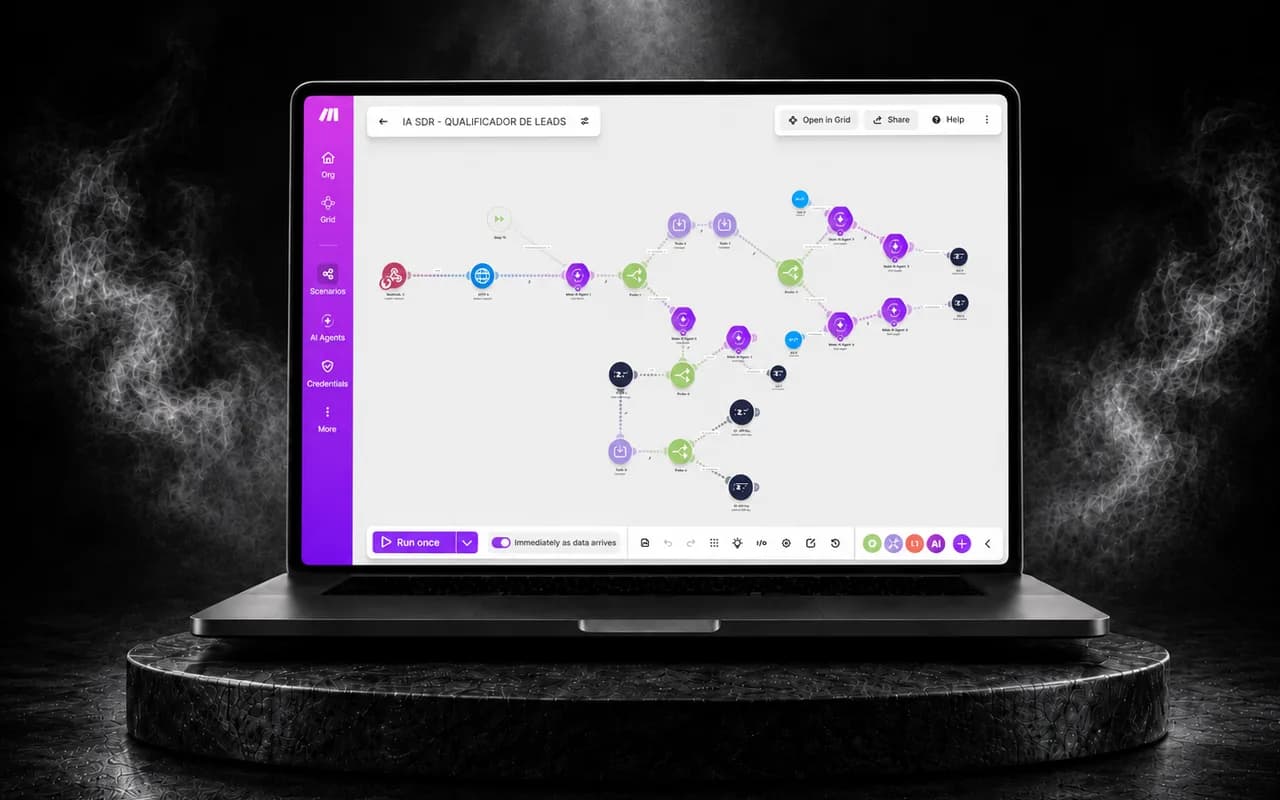
Muda Paisagens
AI pre-sales conversations, qualification questions and records in Pipefy, integrated through Make.
See the Muda Paisagens caseEDevsHub builds integrations and automations to move information between systems, organize customer service steps and run defined routines. Before automating, we need to agree on the trigger, the rule, the destination and what happens when something fails.
A flow must also work when the input is incomplete or a service is unavailable. During alignment, we define which situations can proceed automatically and which should stop for human review. AI can take part when the task requires interpretation; deterministic rules still make sense for validations and records.
These are examples of deliverables and acceptance criteria. The proposal defines which ones go into your project and how they will be checked.
Receive an event from a tool and check the fields required for the next step.
Acceptance example: Complete inputs move through the flow; records missing required fields get the agreed routing.
Map the source fields to the fields of a CRM, database or other application.
Acceptance example: A test event creates or updates the correct record. The same event repeated does not create an improper duplicate.
Agree on how the operation identifies a failed attempt and when it can be retried.
Acceptance example: A simulated failure is recorded; the agreed handling allows processing to resume without losing its state.
In customer service or AI interpretation flows, define the points where the team takes over.
Acceptance example: The selected handoff scenario gives the team the agreed context and stops the planned automatic actions.
From the portfolio
AI pre-sales conversations, qualification questions and records in Pipefy, integrated through Make.
See the Muda Paisagens caseDescribe the initial event, the data that moves, the rules and the expected result in each tool.
Validate APIs, permissions, documentation and available environments, as well as the limits of the services involved.
Check the expected path and the agreed exceptions, such as a duplicate event or an unavailable destination.
Document how to monitor the flow, identify a failure and carry out the planned maintenance actions.
Feasibility depends on the access each product offers: API, exports, events or other authorized means. Those options are checked before the scope is confirmed. A tool without adequate access may require another solution.
The choice depends on the flow, the available integrations and the expected maintenance. The Muda Paisagens case uses Make with Pipefy. A project can use an integration platform, code or a combination of both, as needed.
No. When the rules are clear, a conventional integration can solve it. AI is considered when there is an interpretation, classification or customer service task that justifies it and can be evaluated with examples.
The accounts, permissions and services required are identified when the scope is defined. Provider charges and external dependencies should be separated from development in the proposal. The amounts depend on the tools and usage.
Prefer to hire through Workana? See the profile. If the conversation already started on Workana, send the context in the same chat.
To start the conversation, it helps to gather: